May 01, 2026
Word Order in English Sentences: A Beginner’s Guide
In English, word order matters more than in Russian. In Russian, you can say “Я сегодня читаю книгу” and “Сегодня книгу читаю я” — the meaning changes a little, but the sentence is still understandable. In English, you can’t freely move words around.
The good news: the basic pattern is very simple.
Main pattern
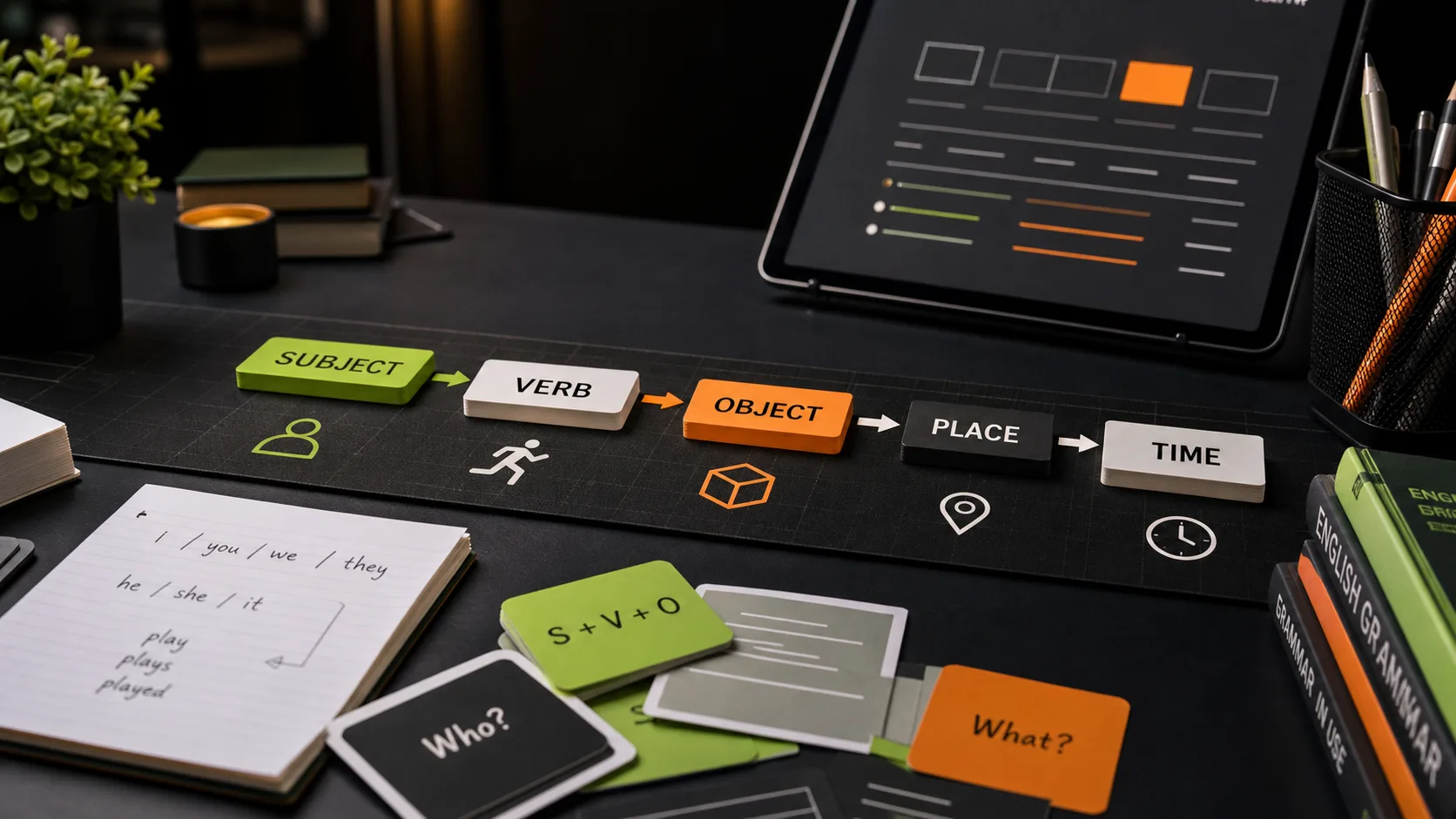
A normal affirmative sentence is built like this:
Who + does what + what / whom + where + when.
Examples:
- I read a book at home every evening.
- She studies English online on Monday.
- We watch videos in the evening.
First comes the person or thing, then the action. This is the core pattern you should make automatic.
Don’t start with time expressions
The Russian sentence “Вчера я смотрел фильм” often leads to the mistake Yesterday watched I a film. The correct forms are:
- I watched a film yesterday.
- Yesterday, I watched a film.
If you are a beginner, stick to the safe pattern: I watched a film yesterday.
Questions are built differently
For questions, you usually need an auxiliary verb:
- Do you like coffee?
- Does she work here?
- Did they call you?
- Are you ready?
- Have you finished?
A question is a separate structure. It is best learned as ready-made patterns too.
Negation
Negatives are formed with not and an auxiliary verb:
- I do not know.
- She does not work here.
- We did not see it.
- I am not ready.
- They have not finished.
Do not try to translate “не знаю” as not know. In English, you need the full structure: I don’t know.
Mini practice
Take one verb and build three types of sentences:
Like:
- I like this word.
- Do you like this word?
- I don’t like this word.
Work:
- She works from home.
- Does she work from home?
- She doesn’t work from home.
Watch:
- We watched a video.
- Did we watch a video?
- We didn’t watch a video.
The main point
Word order should be trained as a habit. First, use the simple pattern: who + action + object + place + time. Once it becomes automatic, questions and longer sentences will feel much easier.