AI + 卡片
2026年4月22日
如何用 ChatGPT 和卡片学习英语而不过载
大多数学习者失败,并不是因为不擅长语言,而是因为系统太混乱:今天看视频,明天抄一串随机单词,然后停很久,节奏就断了。
ChatGPT 很适合解释、举例和设计练习。但如果只是读完回答就走,词汇很快会淡忘。所以我更喜欢把 AI 用来生成材料,再用卡片负责记忆保留。
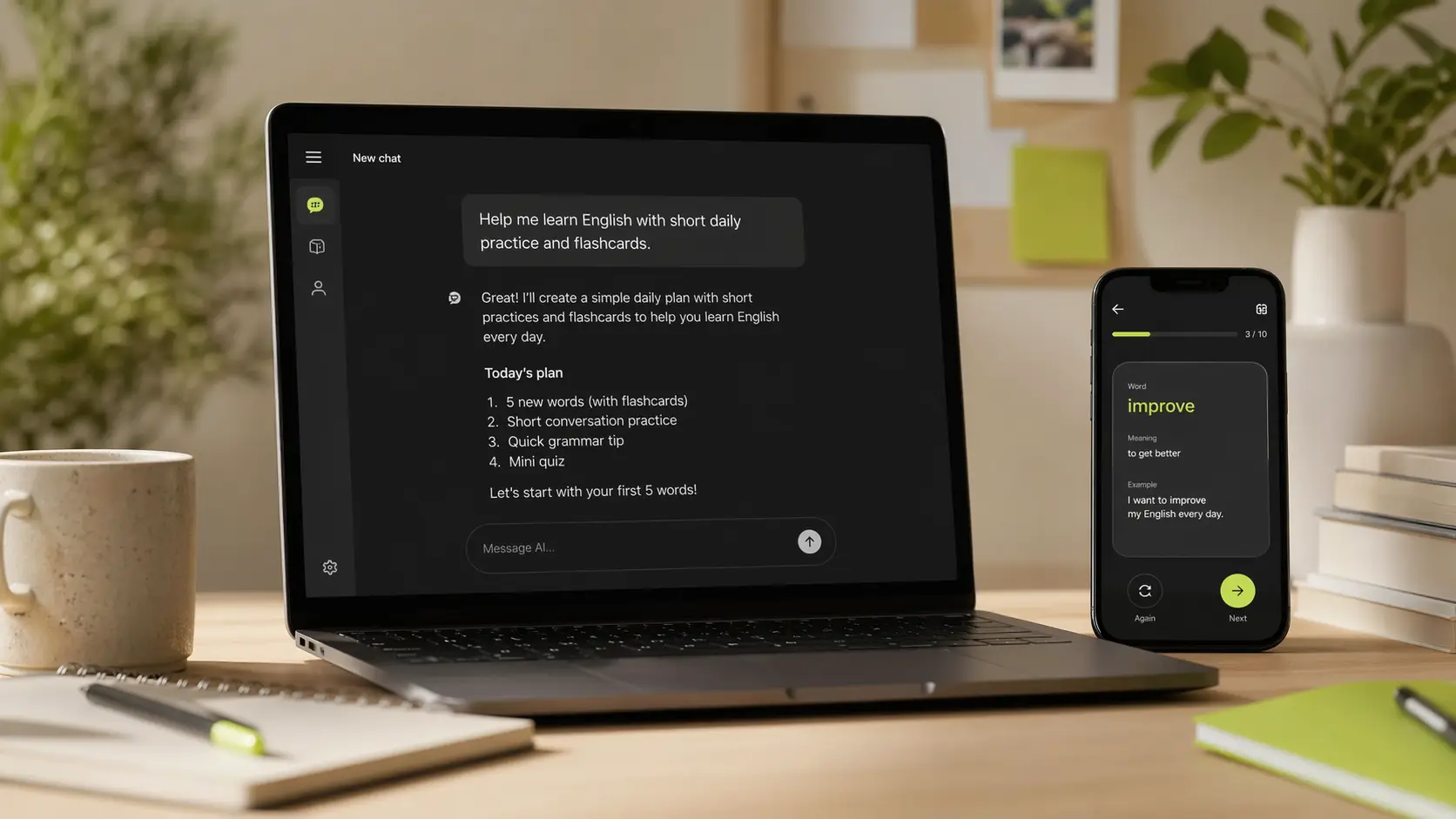
这个方法不依赖强烈动力,而是靠小循环:提出问题,得到有用内容,转入卡片,第二天短复习。
简要说明
- 不要把所有内容都放进卡片,只保留真正想使用的词和短语。
- 一次只处理一个主题:旅行、工作、约会、日常事务或闲聊。
- 每次得到 ChatGPT 回答后,做一个小动作:保存 5-10 个条目,或让它出一个小测验。
Step 1
Use ChatGPT as an editor of practice, not as an endless chat
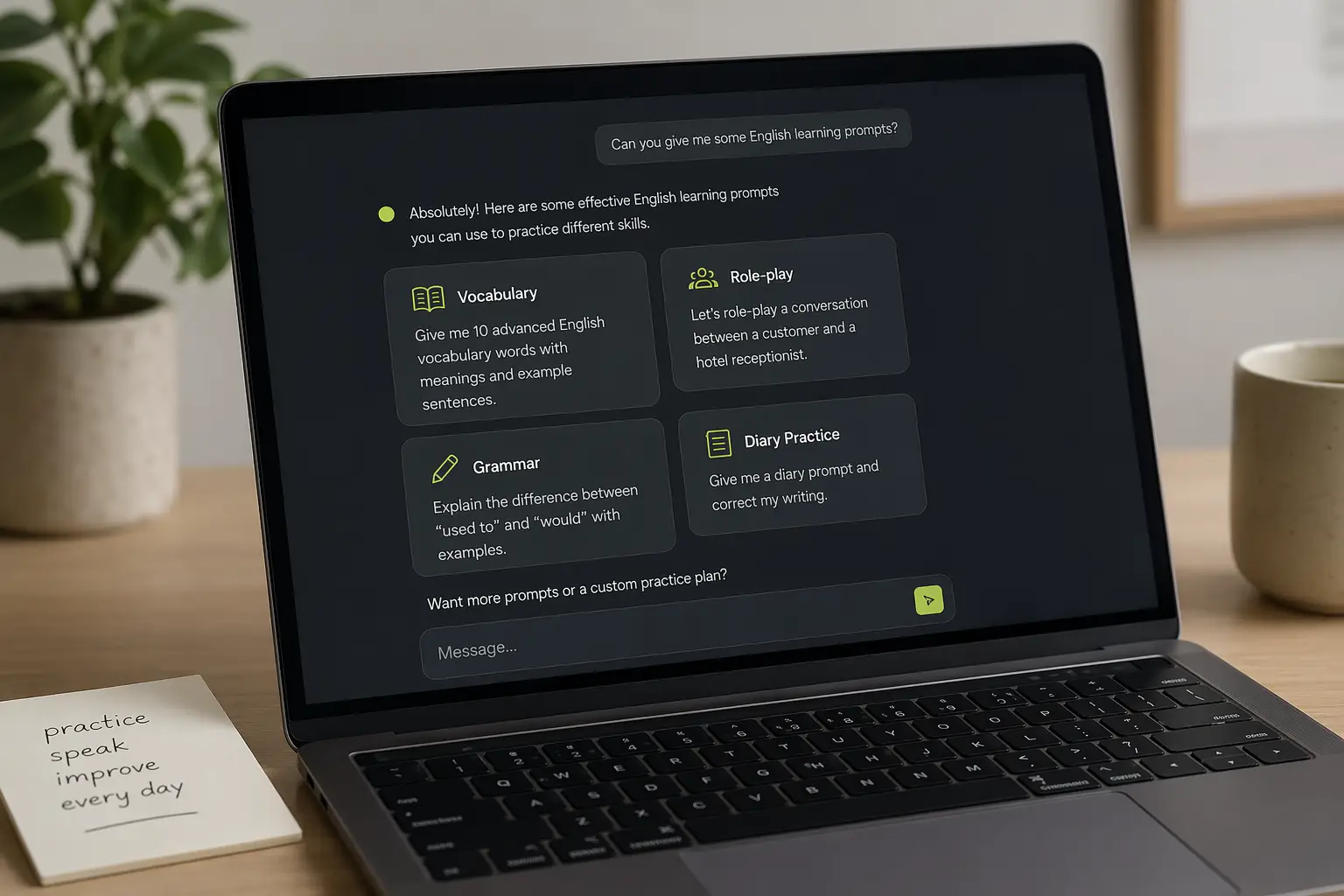
The real strength of AI is not learning for you but generating material around a concrete situation, level, and format.
Ask not just for a word list but for examples, common mistakes, and follow-up questions.
Request dialogues you can continue in the same tone instead of only reading them.
If a grammar point is unclear, ask for a simple explanation and a short exercise right away.
Step 2
Move useful language into flashcards or your memory will not keep it for long
The most common mistake after using AI is reading a good answer and moving on. That is too passive for long-term memory.
Save short phrases you actually want to use in speech or writing.
Do not keep only a translation; add an example or a small context.
Five relevant cards a day beat forty random words you never revisit.
Step 3
Build a short daily loop instead of long rare study sessions
Consistency matters more than scale. Even 10-15 minutes work well if the loop repeats.
Day 1: ask ChatGPT for vocabulary or a dialogue around one topic.
Immediately save 5-10 items into flashcards and keep a short active recall list.
Day 2 and beyond: review cards first, then do one mini quiz or short reply with AI.
Step 4
Do not overload the system: one surface for practice, another for retention
When each tool has a clear role, learning feels lighter. AI helps you generate and practice; flashcards keep the language from disappearing the next day.
Do not try to run the whole learning process inside one chat window.
Treat ChatGPT as a coach and task generator, not as your final storage layer.
Your cards and lists should hold only filtered material that truly matters.
可以马上使用的提示词
下面是简单模板。只需要替换主题和水平。不必一次全用,今天先选一个试试。
Topic vocabulary
When you need useful language for a real situation instead of random words
After the response, move only the words you truly need into flashcards instead of saving the whole list.
Give me 15 useful words and phrases on the topic of [topic] for my level [A1/A2/B1/B2]. For each item, include: 1. a simple explanation, 2. one natural example, 3. a common mistake learners make, 4. a short practice question.
Useful phrases
When you want ready-to-use phrases instead of isolated words
This is useful for speaking because you learn ready-to-use chunks instead of single words.
Give me 20 natural phrases I can actually use in real life when talking about [topic]. My level is [level]. Make them sound modern and everyday, not textbook-like.
Mini dialogues
When you want context and natural phrases
The best lines from the dialogue should go straight into flashcards or a dedicated speaking review list.
Create a short realistic dialogue on the topic [topic] for level [level]. Use natural everyday language, not textbook phrases. After the dialogue, explain 8 key words and expressions and give me 5 follow-up questions so I can answer in the same style.
Role-play
When you want to practice a real conversation scenario
Useful for cafes, airports, dates, doctor visits, job interviews, and everyday situations.
Let's do a role-play. We are in [place]. You are [role], I am [role]. Keep the dialogue realistic and simple for my level [level]. Correct my mistakes only after I answer.
Listening
When you want active listening practice
You can use songs, videos, or podcasts and turn them into small exercises.
Create a listening exercise based on the song [song name]. Remove some key words from the lyrics and turn it into a fill-in-the-gap task. Then check my answers.
Grammar without overload
When a grammar point needs a simple explanation and immediate practice
Do not try to close all grammar in one evening. One point, some practice, then a review the next day.
Explain [grammar topic] in very simple language for a [level] learner. Use clear logic, short examples, and compare it with similar grammar if needed. Then give me 7 short practice tasks and check my answers after I reply.
Grammar game
When you want grammar practice without boring drills
This makes grammar concrete because you see where it appears in real language.
Create a mini game to practice [grammar topic] for level [level]. No boring fill-in-the-gap tasks. Use situations, choices, short dialogues, and quick challenges.
Diary practice
When you want to learn through your own life
A good way to start thinking and writing about your real life, not only doing exercises.
I want to write a short diary entry in English every day. Ask me 3 simple questions about my day, then correct my text and explain my mistakes in an easy way.
Small talk
When you want to get better at starting casual conversations
Useful if you understand a lot but do not know how to start a simple conversation.
Give me 15 common small talk questions and answers for everyday life. Make them natural, short, and easy to remember. Then ask me 5 of them and correct my replies.
Work English
When you need English for work communication
Useful when you need quick preparation for calls, emails, or everyday work chats.
Give me useful English phrases for work communication about [topic: meetings / deadlines / feedback / emails]. My level is [level]. Add examples and one short practice task.
Travel English
When you want practical travel language
After that you can quickly turn the phrases into a mini list or travel flashcards.
I am going to [country/city]. Give me the most useful English phrases for: 1. airport, 2. hotel, 3. cafe, 4. asking for help, 5. small talk. My level is [level].
Interview practice
When you need job interview practice
Useful when you want to rehearse common questions before the real interview.
Act like an interviewer for a [job] position. Ask me interview questions one by one in English. After each answer, correct my mistakes and suggest a better version.
Active recall
When the words are collected and you want to test whether you can truly recall them
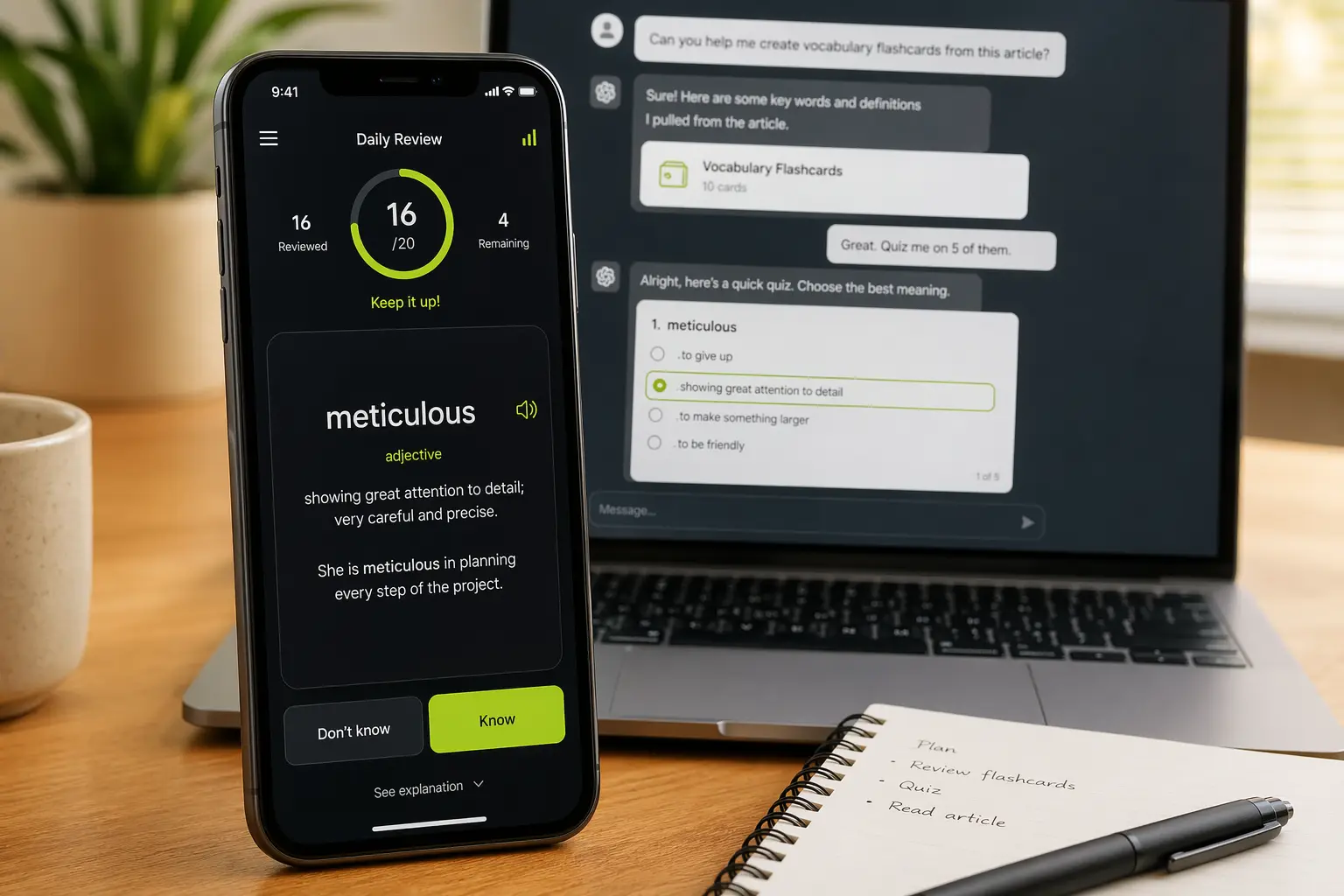
This works especially well after moving words into flashcards: review first, then run active recall with ChatGPT.
I am learning these words: [insert words]. Create a practice set that forces me to recall them actively: 1. short situations, 2. sentence transformations, 3. mini translation tasks, 4. open-ended questions. Do not make it too easy. Wait for my answers and then correct them.
Word review
When you want to review vocabulary in different ways
This helps you revisit the same vocabulary without the feeling of repeating the same exercise.
Yesterday I learned these words: [list]. Test me on them in different ways without showing the answers too early.
Daily routine
When you want a simple daily learning loop
A good option if you want to open the chat each day and not think about what to do next.
Be my English practice partner for 10 minutes a day. Every day give me: 1. 3 useful words, 2. 2 short questions, 3. 1 tiny grammar task, 4. 1 review from previous days. Keep it light and practical.
下一步
如果你不是把 ChatGPT 当成无尽聊天,而是当作准备适合自己材料的工具,学习会简单很多。关键不是提示词数量,而是新语言有没有进入规律练习。
如果今天开始,你会先选哪一种:实用词汇、小对话,还是一个小语法点?
把这篇文章变成你自己的学习系统
把单词和短语保存到词表,用卡片复习,并每天用短时间回顾。这样 ChatGPT 就不只是聊天,而会成为真实学习节奏的一部分。