AI + flashcards
April 22, 2026
How to Learn English with ChatGPT and Flashcards Without Overload
Most learners do not fail because they are bad at languages. They fail because their system is chaotic: a video today, a random word list tomorrow, then a break long enough to erase the momentum.
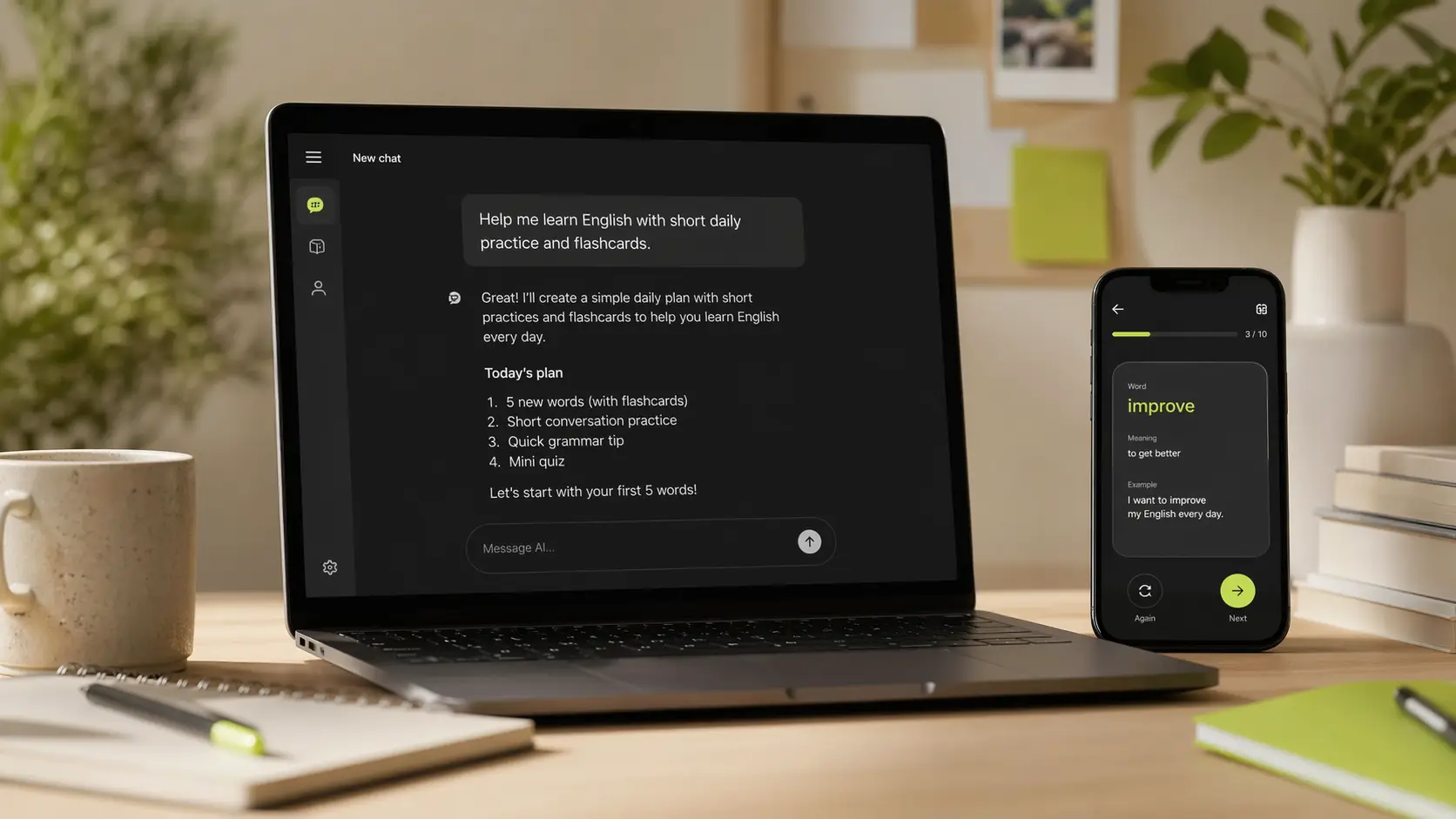
ChatGPT is excellent for explanations, examples, and practice. But if you only read the output and move on, vocabulary fades quickly. That is why I like the combination of AI for generating material and flashcards for retention.
This approach does not depend on heroic motivation. It works through small cycles: prompt, useful output, transfer to cards, short review the next day.
Коротко, как это работает
- Do not move everything into flashcards. Keep only the words and phrases you genuinely want to use.
- Work on one topic at a time: travel, work, dating, errands, or small talk.
- After each ChatGPT response, do one small action: save 5-10 items or ask for a mini quiz.
Step 1
Use ChatGPT as an editor of practice, not as an endless chat
The real strength of AI is not learning for you but generating material around a concrete situation, level, and format.
Ask not just for a word list but for examples, common mistakes, and follow-up questions.
Request dialogues you can continue in the same tone instead of only reading them.
If a grammar point is unclear, ask for a simple explanation and a short exercise right away.
Step 2
Move useful language into flashcards or your memory will not keep it for long
The most common mistake after using AI is reading a good answer and moving on. That is too passive for long-term memory.
Save short phrases you actually want to use in speech or writing.
Do not keep only a translation; add an example or a small context.
Five relevant cards a day beat forty random words you never revisit.
Step 3
Build a short daily loop instead of long rare study sessions
Consistency matters more than scale. Even 10-15 minutes work well if the loop repeats.
Day 1: ask ChatGPT for vocabulary or a dialogue around one topic.
Immediately save 5-10 items into flashcards and keep a short active recall list.
Day 2 and beyond: review cards first, then do one mini quiz or short reply with AI.
Step 4
Do not overload the system: one surface for practice, another for retention
When each tool has a clear role, learning feels lighter. AI helps you generate and practice; flashcards keep the language from disappearing the next day.
Do not try to run the whole learning process inside one chat window.
Treat ChatGPT as a coach and task generator, not as your final storage layer.
Your cards and lists should hold only filtered material that truly matters.
Промпты, которые можно взять прямо сейчас
Ниже простые заготовки. Просто меняйте тему и свой уровень. Не надо брать всё сразу: выберите один промпт и попробуйте его сегодня.
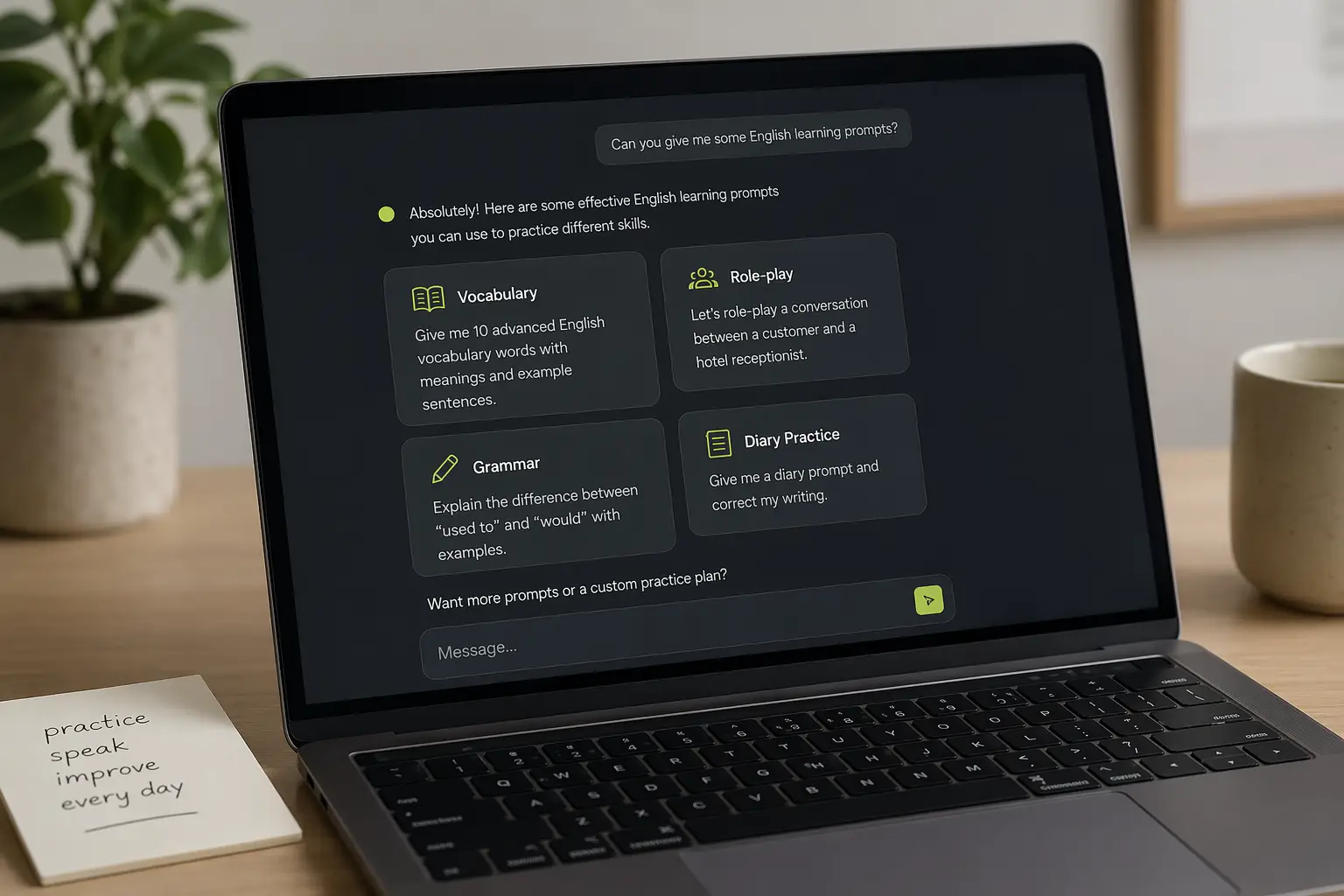
Topic vocabulary
When you need useful language for a real situation instead of random words
After the response, move only the words you truly need into flashcards instead of saving the whole list.
Give me 15 useful words and phrases on the topic of [topic] for my level [A1/A2/B1/B2]. For each item, include: 1. a simple explanation, 2. one natural example, 3. a common mistake learners make, 4. a short practice question.
Useful phrases
When you want ready-to-use phrases instead of isolated words
This is useful for speaking because you learn ready-to-use chunks instead of single words.
Give me 20 natural phrases I can actually use in real life when talking about [topic]. My level is [level]. Make them sound modern and everyday, not textbook-like.
Mini dialogues
When you want context and natural phrases
The best lines from the dialogue should go straight into flashcards or a dedicated speaking review list.
Create a short realistic dialogue on the topic [topic] for level [level]. Use natural everyday language, not textbook phrases. After the dialogue, explain 8 key words and expressions and give me 5 follow-up questions so I can answer in the same style.
Role-play
When you want to practice a real conversation scenario
Useful for cafes, airports, dates, doctor visits, job interviews, and everyday situations.
Let's do a role-play. We are in [place]. You are [role], I am [role]. Keep the dialogue realistic and simple for my level [level]. Correct my mistakes only after I answer.
Listening
When you want active listening practice
You can use songs, videos, or podcasts and turn them into small exercises.
Create a listening exercise based on the song [song name]. Remove some key words from the lyrics and turn it into a fill-in-the-gap task. Then check my answers.
Grammar without overload
When a grammar point needs a simple explanation and immediate practice
Do not try to close all grammar in one evening. One point, some practice, then a review the next day.
Explain [grammar topic] in very simple language for a [level] learner. Use clear logic, short examples, and compare it with similar grammar if needed. Then give me 7 short practice tasks and check my answers after I reply.
Grammar game
When you want grammar practice without boring drills
This makes grammar concrete because you see where it appears in real language.
Create a mini game to practice [grammar topic] for level [level]. No boring fill-in-the-gap tasks. Use situations, choices, short dialogues, and quick challenges.
Diary practice
When you want to learn through your own life
A good way to start thinking and writing about your real life, not only doing exercises.
I want to write a short diary entry in English every day. Ask me 3 simple questions about my day, then correct my text and explain my mistakes in an easy way.
Small talk
When you want to get better at starting casual conversations
Useful if you understand a lot but do not know how to start a simple conversation.
Give me 15 common small talk questions and answers for everyday life. Make them natural, short, and easy to remember. Then ask me 5 of them and correct my replies.
Work English
When you need English for work communication
Useful when you need quick preparation for calls, emails, or everyday work chats.
Give me useful English phrases for work communication about [topic: meetings / deadlines / feedback / emails]. My level is [level]. Add examples and one short practice task.
Travel English
When you want practical travel language
After that you can quickly turn the phrases into a mini list or travel flashcards.
I am going to [country/city]. Give me the most useful English phrases for: 1. airport, 2. hotel, 3. cafe, 4. asking for help, 5. small talk. My level is [level].
Interview practice
When you need job interview practice
Useful when you want to rehearse common questions before the real interview.
Act like an interviewer for a [job] position. Ask me interview questions one by one in English. After each answer, correct my mistakes and suggest a better version.
Active recall
When the words are collected and you want to test whether you can truly recall them
This works especially well after moving words into flashcards: review first, then run active recall with ChatGPT.
I am learning these words: [insert words]. Create a practice set that forces me to recall them actively: 1. short situations, 2. sentence transformations, 3. mini translation tasks, 4. open-ended questions. Do not make it too easy. Wait for my answers and then correct them.
Word review
When you want to review vocabulary in different ways
This helps you revisit the same vocabulary without the feeling of repeating the same exercise.
Yesterday I learned these words: [list]. Test me on them in different ways without showing the answers too early.
Daily routine
When you want a simple daily learning loop
A good option if you want to open the chat each day and not think about what to do next.
Be my English practice partner for 10 minutes a day. Every day give me: 1. 3 useful words, 2. 2 short questions, 3. 1 tiny grammar task, 4. 1 review from previous days. Keep it light and practical.
Что делать дальше
If you use ChatGPT not as endless conversation but as a tool for preparing material that fits you, learning becomes simpler. The key is not the number of prompts but whether new language turns into regular practice.
Which topic would you start with first: useful vocabulary, mini dialogues, or a small grammar block?
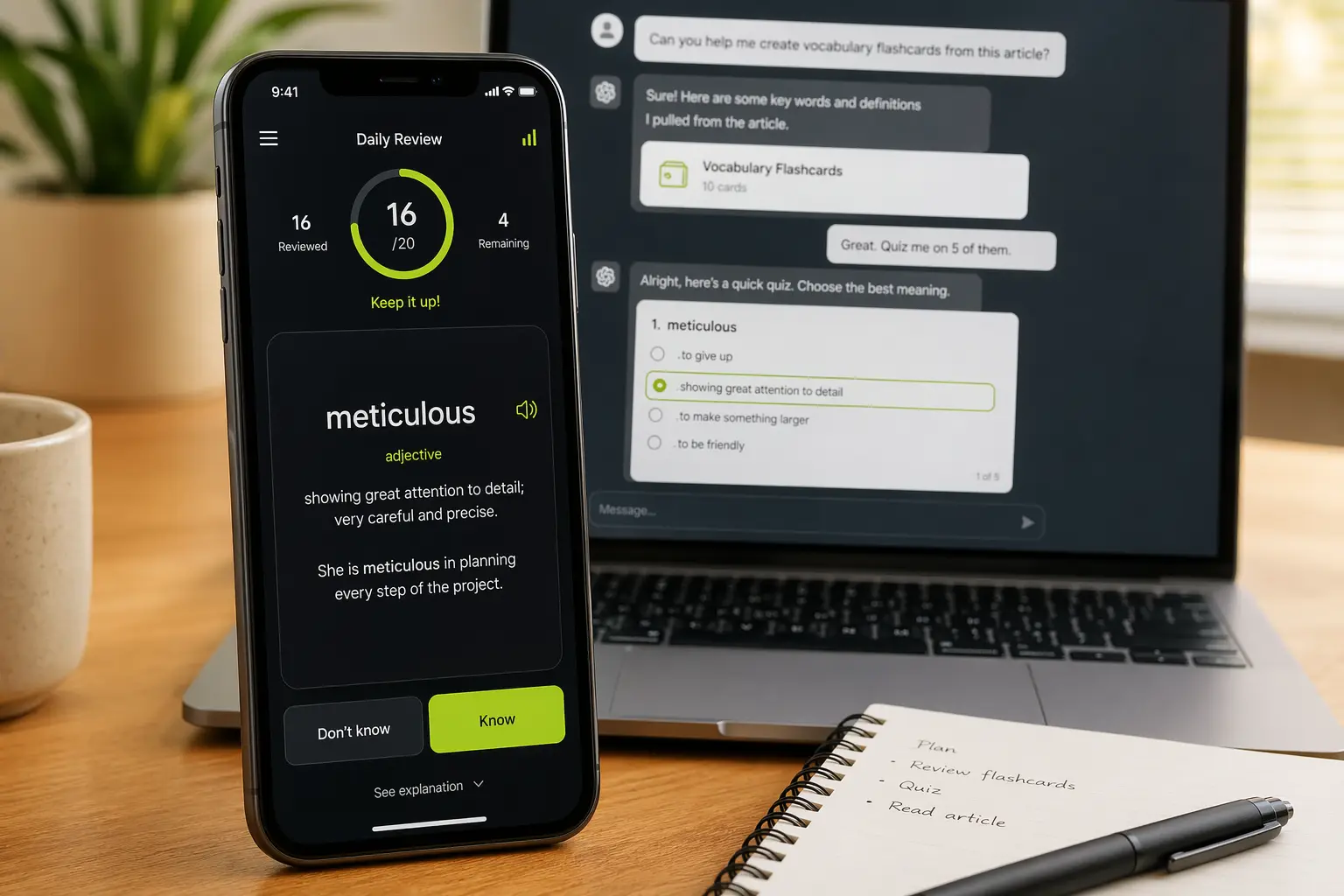
Turn this article into your own learning system in the app
Save words and phrases into lists, review them in flashcards, and revisit them through short daily sessions. That is how ChatGPT stops being just a chat and becomes part of a real routine.