May 01, 2026
Present Simple and Present Continuous: What’s the Difference in Simple Words
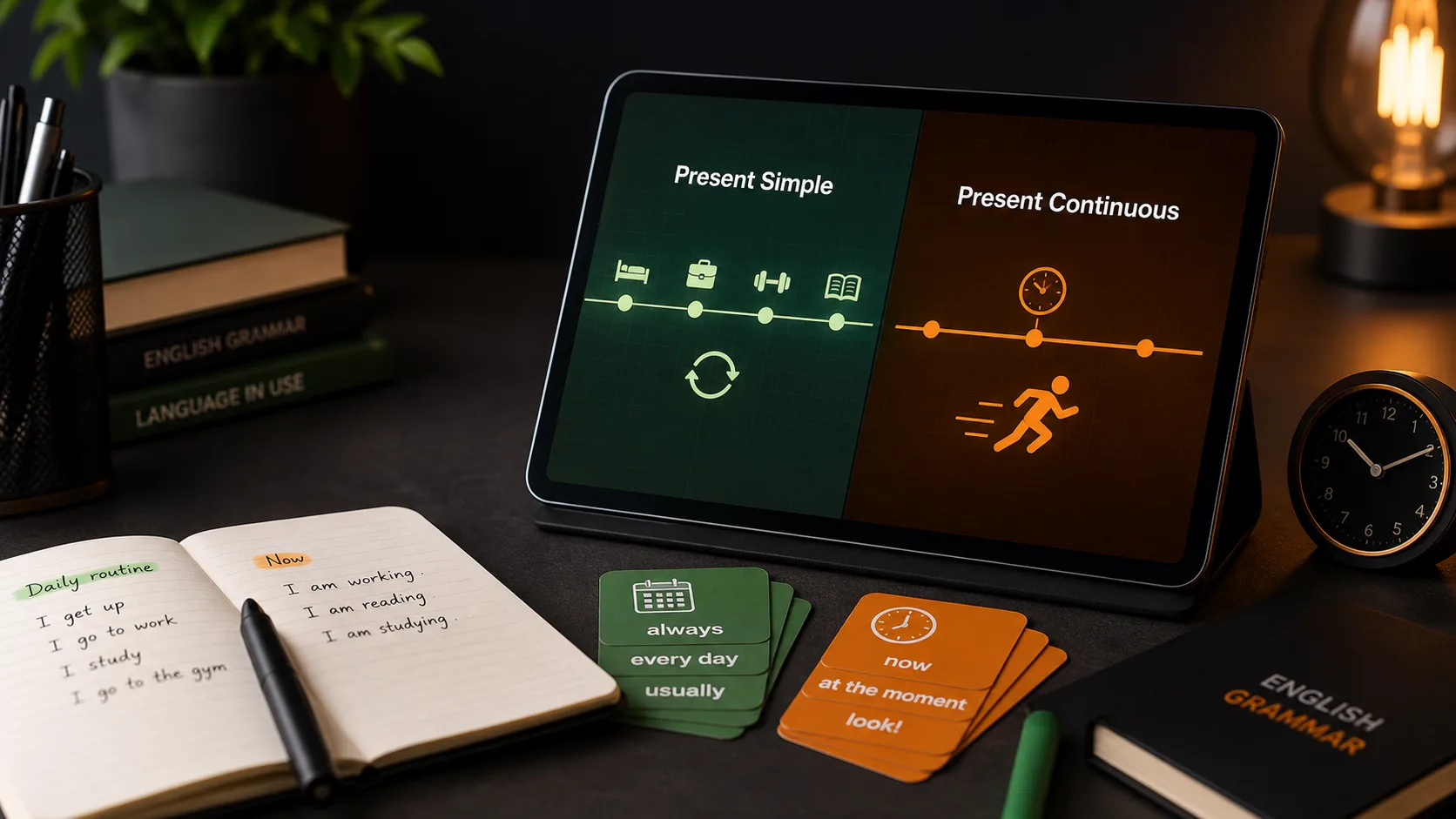
Present Simple and Present Continuous are often confused because both tenses talk about the present. The difference is not in the word “present,” but in how we look at the action: as a fact or as a process happening now.
If you remember this idea, the rules become much clearer.
Present Simple: facts, habits, schedules
Present Simple is used when an action repeats or is a fact:
- I work every day.
- She studies English.
- We live in Berlin.
- The shop opens at 9.
Here, it does not matter whether the action is happening right now. What matters is that it is usually true.
Signal words: usually, often, always, sometimes, every day, every week.
Present Continuous: a process now or a temporary situation
Present Continuous is used when an action is happening now or during the current period:
- I am working now.
- She is studying at the moment.
- We are learning English this month.
- They are watching a video.
It does not have to mean this exact second. The sentence I am reading an interesting book can mean that I am reading it these days.
Signal words: now, right now, at the moment, today, this week.
Compare the pairs
I work from home. — I usually work from home.
I am working from home today. — I am working from home today.
She studies English. — She studies English in general.
She is studying English now. — She is studying English now.
We live in London. — We live in London.
We are living in London for two months. — We are living in London temporarily for two months.
A common mistake with state verbs
Some verbs are rarely used in Continuous: know, like, love, want, need, understand. We usually say:
- I know this word.
- I like coffee.
- I need help.
Phrases like I am knowing or I am needing sound incorrect in normal speech.
How to practice
Take 10 actions from your own life and make pairs:
- I usually read in the evening.
- I am reading an article now.
- I work every day.
- I am working on a project today.
This kind of practice is better than an abstract exercise with no connection to your life.
The main idea
Present Simple is a habit or a fact. Present Continuous is a process happening now or a temporary situation. Learn the tenses through pairs of phrases, and the difference will quickly start to feel natural.